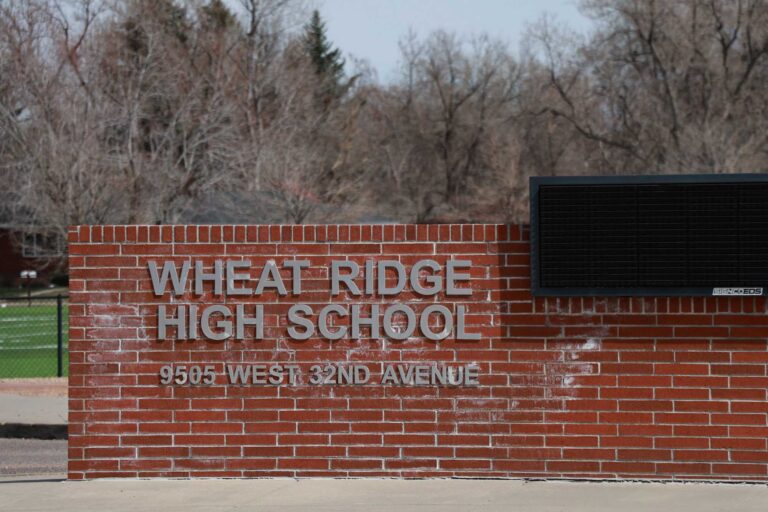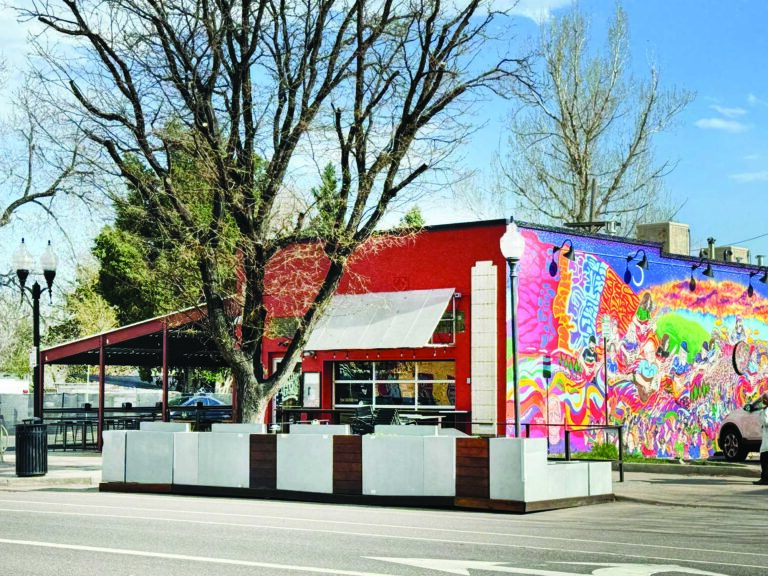



CITY AT SUNSET-- This style of lamp post and the neon clocks on 38th Avenue and Depew Street, are reminders of the city’s previous attempts to beautify “Main Street”. Wheat Ridge is going forward with the “Road Diet” plan – restriping and narrowing of 38th Avenue – between Depew and Upham streets. The bidding process may begin as early as February or March. If council approves a contractor bid, work is slated to start in spring or early summer. PHOTOS: CYNDY BEAL
BY CYNDY BEAL
Whether you like plans for Wheat Ridge’s Main Street depends on whether you like diets – Road Diets, to be exact.
Studies, committees, plans and meetings for the future of 38th Avenue has proceeded in fits and starts for over a decade, and the public got its chance to see and comment earlier this month.
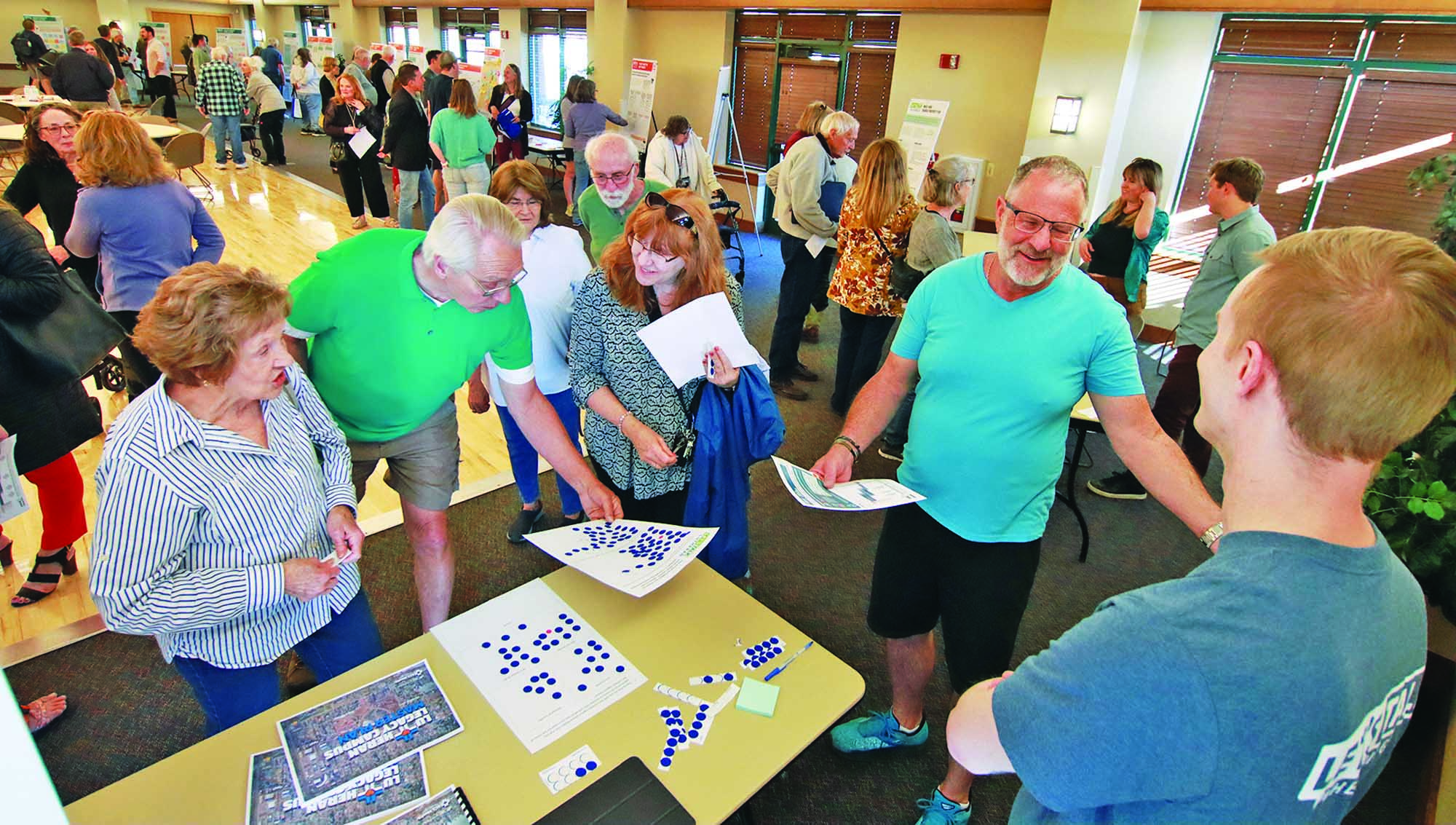
The city of Wheat Ridge hosted two open houses for the 38th Avenue Roadway Design at the Wheat Ridge Recreation Center on the morning and early evening of Jan. 5. Road draft plans were displayed showing the “Road Diet” plan – restriping and narrowing of 38th Avenue – between Depew and Upham streets.
At the Open House, a paper draft spanning several feet hung on the wall.
Wheat Ridge Projects Supervisor Mark Westberg explained the many benefits of the Road Diet model. The plan takes the avenue down to three lanes, two for direct traffic, and one for a center turning lane.
Some businesses and residents were not in favor. Concerns about the impact on businesses, emergency vehicles access and possible increases in emissions were raised.
Jim Meeker, owner of Meeker Auto Sales on 38th Avenue, points to Tennyson Street and disagrees with Westberg’s claim that slowing down speeds on a road allows people to see more businesses, thus improving revenue streams for business owners and the city through increased sales taxes.
“When I drive down Tennyson Street I’m paying attention to cars pulling out and car doors opening and not looking at businesses,” said Meeker.
Westberg later said, as a passenger, he sees more businesses and has better views of the street in general at lower speeds. In addition, he said Tennyson has two lanes and no center turning lane, and isn’t an accurate comparison.
According to the 38th Avenue Corridor Study Road Diet Traffic Analysis, “Alternatives 1 and 3 [the present corridor plan] have the least impact to travel time with both options causing only 40 seconds or less of added delay in the corridor.”
The narrowing could add close to a minute at the most, at peak-hours, of drive time on the over a mile-and-a-half stretch. Westberg said they didn’t expect diversion traffic on 44th Avenue or 32nd Street as a result of the fewer lanes. He said construction, in front of individual business sites, would take a couple of days, with work most likely being performed at night.
Read more: 38th Avenue Plan Progresses Benefits, Pitfalls Generate Debate
BY J. PATRICK O'LEARY
Renewal Wheat Ridge, the governing board for the City of Wheat Ridge’s Urban Renewal Authority, has been busy on the development of the vacant lot behind the First Bank Building at the corner of Wadsworth Blvd. and 44th Ave., part of the Town Center North redevelopment project. The current work involves the extension of Vance St., which will serve a new senior housing apartment complex and retail and office development.
“The Town Center North (44th & Wadsworth Blvd.) redevelopment project has been on my radar screen since I was elected in 2005,” says Wheat Ridge Mayor Jerry DiTullio. “The site has sat mostly vacant and has been an unproductive eyesore in our fine city for over 40 years.”
Earlier this year an antique mall was demolished in preparation to build infrastructure for the project: public roads on 43rd Ave. and Vance Street, site grading and installation of storm water detention pond on the northeast corner of site, curb and gutter, water, sanitary and storm water utilities, street and pedestrian lights and landscaping.
Stakes were in place by December for grading, which was expected to be completed by mid-January, according to a project update provided by contractor Weston Solutions.
Progress was unremarkable, with no injuries, but while excavating a storm water detention pond, Weston reported encountering stained soil near an old gas station – remnants of a remediation system—which was then stockpiled and sampled for proper, off-site disposal.
Wheat Ridge’s Urban Renewal Authority purchased the 9.4-acre redevelopment site in the spring of 2008. The 88-unit, age-restricted apartment complex will be located on two-acres on the southeastern portion of parcel, which was sold to developer Wazee Partners.
Read more: Town Center North Redevelopment: Whole Lot A Gradin’ Goin’ On
BY J. PATRICK O'LEARY
You may not have noticed, but early construction has started on the Gold Line, the 11.2-mile electric commuter rail line between Denver Union Station and Ward Road in Wheat Ridge, part of the Regional Transportation District’s FasTracks project. Full construction – roadbed, track, structures – won’t start until late summer or fall.
Final design has been underway since August 2010, but construction could not begin until receipt of a $1.03 billion federal grant, which was announced at the Gold Line groundbreaking in Arvada four months ago, according to Kevin Flynn, Public Information Manager for the project.
“The early construction consists of utility relocations,” says Flynn. “Two such pieces of work have been completed on Denver Water lines in the section of the project that is shared with the Northwest Rail in Denver. These were near 38th Avenue and Fox Street, and 48th Avenue and Fox Street. Water line relocation is underway on other locations on 48th Avenue and on the site of the former Denver Post printing plant. Demolition of buildings, including one already taken down on the old Post plant property, will continue this quarter. In the near term, these will be in the Denver portion of the line.”
Crews will begin moving wastewater and gas lines in the path of the new tracks in the next three months. Sixty utility relocations will be performed as part of the project.
RTD will begin the process of acquiring right-of-way from private property owners as well.
“There are a total of 96 parcels on the Gold Line, 44 of which have been acquired from either the railroads or the cities and Adams County,” says Flynn, “but the other 52 parcels are privately owned. RTD has assembled updated legal descriptions for appraisers to start the acquisition process and notices of intent to acquire are ready to be mailed to the first set of owners, including parcels at the Ward Road and Arvada Ridge stations.”
The Gold Line generally follows the path of the freight railroads north out of Denver Union Station to Utah Junction, east of 60th Avenue and Pecos Street, where it turns west and follows the BNSF Railway line into Olde Town Arvada and on to Wheat Ridge. There are seven stations on the Gold Line in addition to the terminal at Denver Union Station. They are at 41st Avenue and Fox Street, Pecos, Federal, Sheridan, Olde Town, Arvada Ridge and Ward Road.
The opening of the Gold Line is scheduled for summer 2016, and the current schedule has trains operating every 15 minutes in each direction throughout the day between 6 a.m. and 7 p.m., and every 30 minutes between 4 and 6 a.m. and from 7 p.m. to midnight.
For more information, visit www.rtd-fastracks.com or call the project hotline, 303-299-2000.
BY DIANNA PRUDEN, MT (ASCP) SBB
Blood Bank and QA Manager,Exempla Lutheran Medical Center
On September 7, Dianna Cillessen arrived at Exempla Lutheran Medical Center anticipating the birth of her second child. After carrying her baby for 39 weeks, she delivered a healthy, 8 lbs. 3oz. boy named Beau. Then the unexpected transpired. With no warning, Dianna began to hemorrhage. For the next few hours a team of doctors, nurses, and medical professionals worked at a furious pace to keep Dianna alive.
While the average adult holds approximately 12 units of blood in their body – Dianna received 41 units that day. At one point, Dianna had no blood pressure or pulse. Dianna experienced an amniotic fluid embolism (AFE). Most women, including women who have had children, have never heard of it because AFE is so rare that most physicians will never encounter it in their professional careers.
Due to the amazing skills of the medical staff and the 41 unknown blood donors, Dianna survived this traumatic experience. It is no wonder that Dianna’s anesthesiologist told her, “You are a miracle!” It took the right combination of professionals and citizen donors to save Dianna Cillessen and bring Beau’s mom home.